Expand Your YOUNIVERSE · Dell Technologies · Campaign design system
Turning an agency concept into something Dell could build.
A creative agency designed Dell's YOUNIVERSE campaign for 18 to 34 year olds around the world. Dell's own engineers had to build it inside Dell's content system. I was the design lead in between, making sure what shipped still matched the idea across three phases and global markets.
130% more engagement
User engagement rose 130% with the campaign experience.
3 phases, 12 months
Each release rolled out to more markets, building on the one before.
Configure, not redesign
By the last phase, launching a new market meant setting up components, not starting new design work.
01 · The problem
A bold concept nobody had designed for Dell's systems.
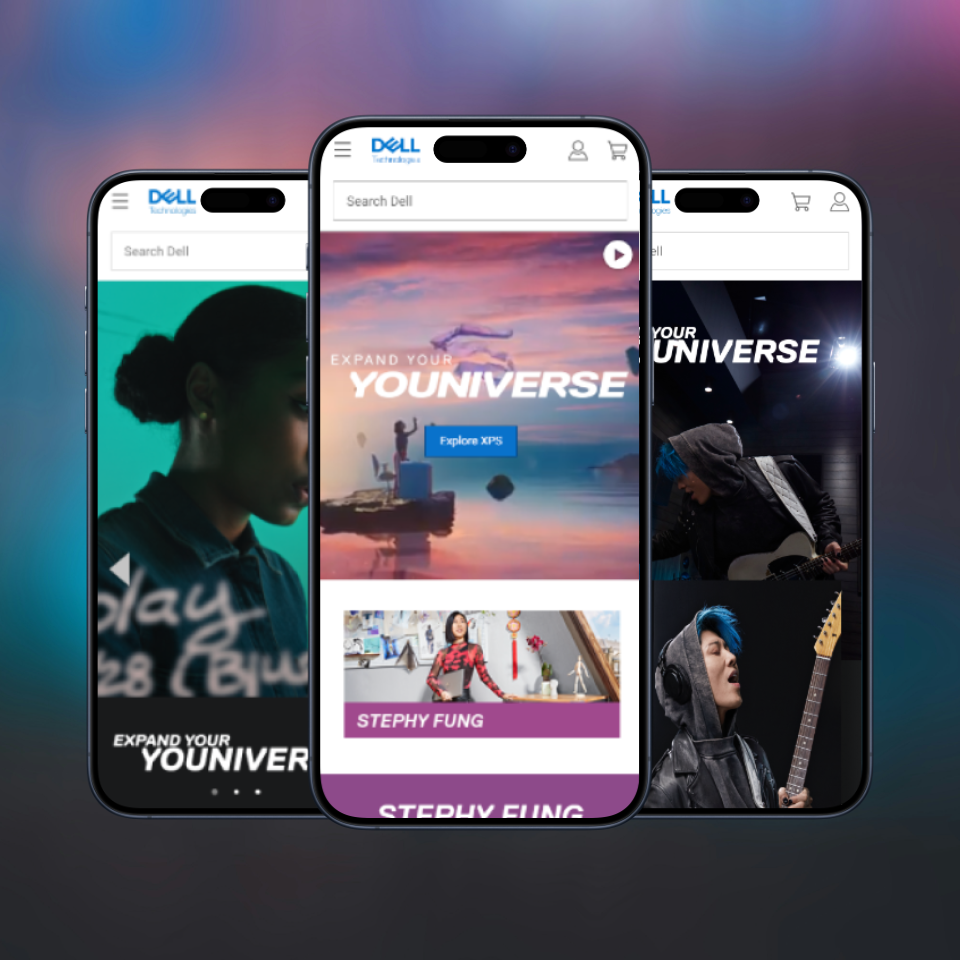
The agency delivered an immersive, personality-driven concept built around creators' stories. It was meant to feel unlike anything Dell had done before. What it hadn't been designed for was AEM, Dell's global marketing workflows, or the engineering team that would actually build it.
My job was to close that gap without watering the idea down. That meant keeping what made the concept work while fitting it inside limits that neither the agency nor engineering could fully see from where they sat.
The agency designed for the ideal. Engineering built in the real. Both were right about their part.
To do that, I had to speak both languages: the agency's creative intent and Dell's technical constraints. Most of the useful answers came from holding both at once.
02 · The approach
Build the system first. Then scale it.
Phase 1 wasn't only the launch. It was the component system. Instead of designing each market's version separately, I built a reusable set of modules that regional teams could set up and adapt themselves. It meant more work up front in exchange for much less work, and much more consistency, in every phase after.
Phase 1 · Launch
Build the components
A reusable library of campaign modules, designed so regional teams could configure them without new design work per market.
Phase 2 · Expand
Add interactive features
New interactive pieces built on Phase 1 components, with no rebuild needed.
Phase 3 · Roll out
Launch new markets
New markets became a setup task, not a design project.
03 · Key decisions
The biggest decisions were about what not to design.
Phasing
I treated the phases as a way to learn, not just a schedule.
Three releases gave us real user behavior before we committed to the next one. Phase 1 was as much about learning what resonated as it was about launching, and that data shaped Phases 2 and 3 in ways a single big launch never could have.
Investment
I put Phase 1 time into the system, not the showpiece pages.
The temptation was to make the launch pages as impressive as possible. I spent that time on the component system instead. That's why later markets could launch at a fraction of the Phase 1 effort.

Negotiation
I found which parts of the concept could bend.
Not every part of the agency's vision mattered equally. I worked with the agency to sort out which elements carried the concept and which could change to fit Dell's constraints without losing the point. That only worked because we built trust and a shared vocabulary first.
04 · What I took from this
Lessons I still use.
A design system pays off the second time, not the first.
Phase 1 looked slower on paper. Every phase after it was faster and more consistent. It's the same trade I made later when rebuilding Tidal Cyber's design system foundation first.
Translation is design work.
The gap between an agency's concept and an internal engineering team is a design problem. It needs someone who can hold both sides at once, not someone who belongs to only one.
Releasing in phases is a research method.
Shipping in stages gave us real behavior to design from, instead of guesses made before launch.
05 · What I'd do differently
I'd get engineering's eyes on the concept earlier. The sooner the people building it can see what the experience needs to do, the sooner we can plan the functionality it takes and the testing it needs, instead of finding those gaps mid-build.