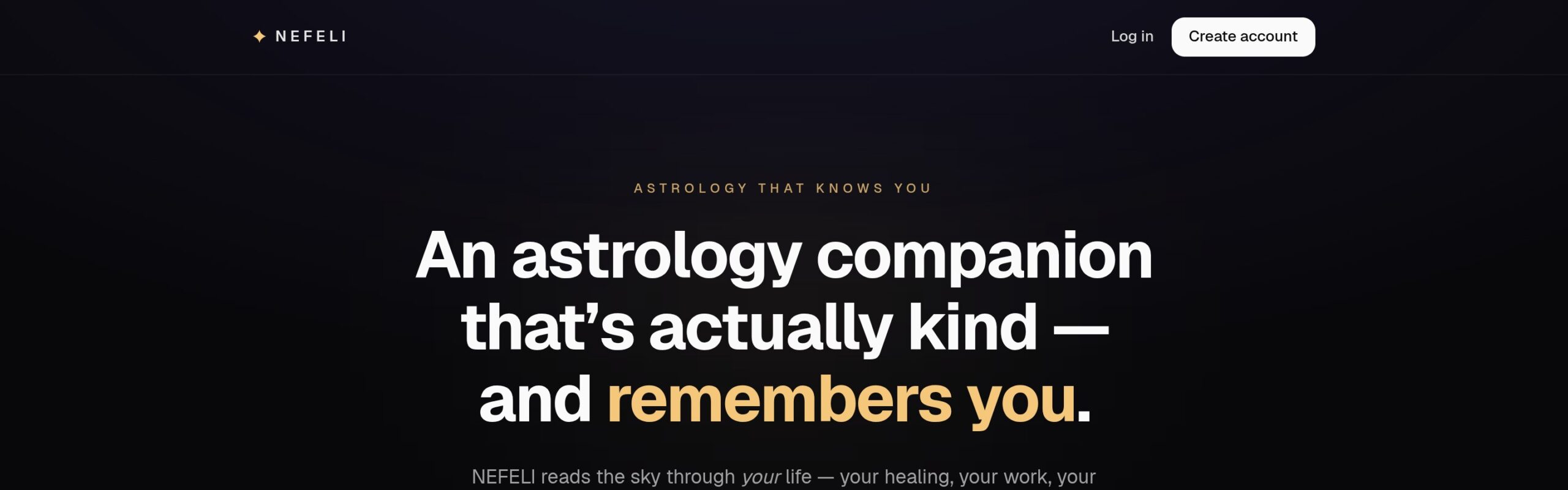
Nefeli — astrology that knows you.
An astrology companion built around a single design question: how do you build an AI that feels like a companion rather than a tool — and stays warm without being sycophantic or fatalistic?
that's actually kind —
and remembers you.
NEFELI reads the sky through your life — your healing, your work, your relationships, your creative practice. It remembers what you tell it, and meets you where you are, day after day.
Nefeli landing page — "ASTROLOGY THAT KNOWS YOU." Warm, unhurried; the visual language communicates depth and care without mysticism or fatalism.
Live · nefeli.kamalacreated.com

A trust-first approach to AI guidance in an inherently personal domain.
Nefeli is an astrology companion that reads your actual chart — healing, work, relationships, creative practice — and remembers what you share day after day. It's built around a single design question: how do you make AI feel supportive rather than authoritative in a domain that is inherently personal and subjective, where being wrong doesn't just waste someone's time, it affects how they understand themselves?
Most astrology apps either serve generic sun-sign content, or lean into fatalism and predictive certainty. Nefeli explores a different approach: warm, contextual, unhurried — and honest about what interpretation can and cannot claim to know.
How do you build an AI that feels like a companion rather than a tool — that stays warm without sliding into sycophancy or fatalism — in a domain where the user brings all of the meaning?
Four choices that define the experience.
Your chart provides language, but Nefeli reads it through what you're actually living — a job transition, a difficult relationship, a period of grief. Context always comes first; the chart is a lens, not a verdict.
A companion that forgets you can't actually support you. Nefeli retains what you share across sessions — not to profile you, but because care requires continuity. What you named last time matters this time.
The tension between kind and honest is real. Nefeli avoids both fatalism ("your Saturn return will be hard") and toxic positivity ("everything happens for a reason"). It sits with difficulty without resolving it prematurely.
Astrology is interpretive, not predictive. When multiple readings are possible, Nefeli says so — and keeps the user in control of which frame resonates — rather than asserting a single meaning with false confidence.
The same trust problems — lower stakes.
The trust problems in Nefeli are the same ones I work on in NARC — just at lower stakes. When analysts use NARC to evaluate AI-generated security findings, the same questions apply: Does the interface communicate the basis for the interpretation? Does it make the AI's limitations visible? Does it keep the human in control of meaning-making?
Building Nefeli gave me a low-stakes environment to prototype companion design patterns — memory, warmth, honest uncertainty, contextual framing — that I then brought to production AI work. The domain doesn't matter; the design problems do.